


Module 7
Managing stress & finding balance

Living in France can mean your usual stress buffers — friends, routines, knowing how things work — can be missing when life gets demanding. This module explains why life can feel more draining than you expected, and gives you practical, research-informed ways to stay grounded and balanced.
What is stress exactly?
Stress is your body's ancient survival system responding to demand. When your brain perceives a threat, it releases adrenaline and cortisol, raising your heart rate and diverting energy towards immediate action. This fight-or-flight response evolved for short, physical dangers: react fast, survive, recover. The trouble is that your brain runs the same program for modern stressors — an ambiguous email, a tax deadline — that can't be fought or fled, and don't neatly end.
Psychologists distinguish between acute stress (a short spike followed by recovery — harmless, and even useful for focus and performance) and chronic stress, where the system stays switched on for weeks or months. Research shows this sustained activation carries real, whole-body costs: disrupted sleep, weakened immunity, impaired concentration, and a raised risk of anxiety and depression.Chronic stress rarely has one dramatic source: the steady accumulation of daily hassles often predicts stress better than major life events do.
The upshot: stress is less of an event and more of an ongoing level — the running balance between what's pouring in and what your system can recover from. And that balance is something you can actively manage. Which brings us to the bucket...
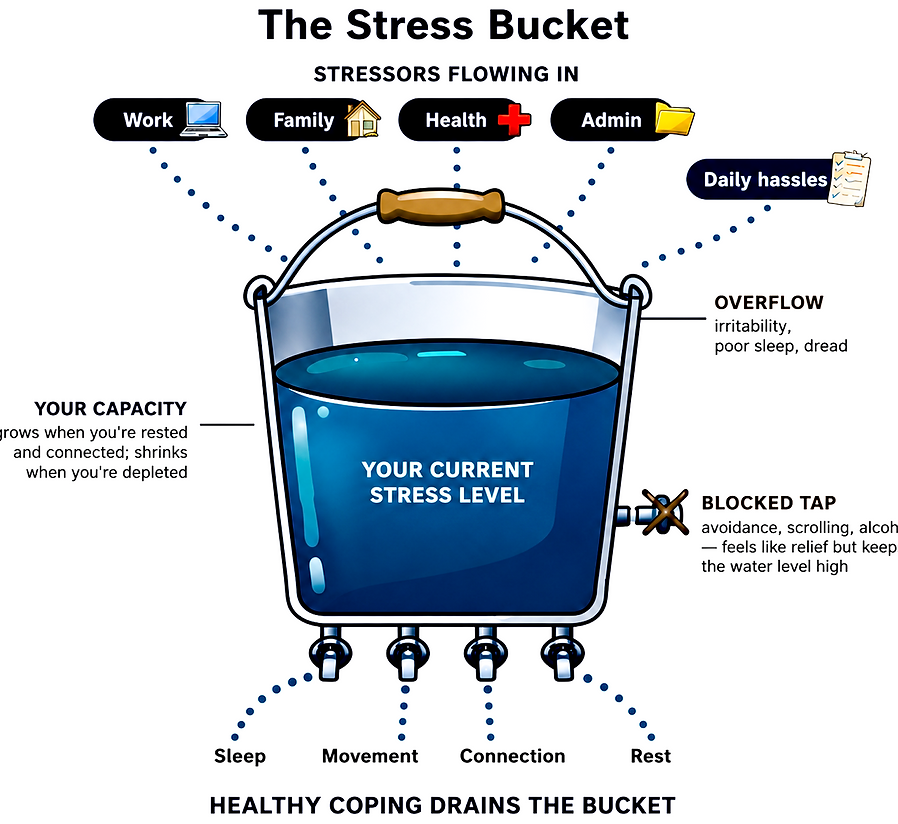
The stress bucket
Imagine you carry a bucket. Every stressor in your life pours water into it.
Water flowing in — your stressors. Everyone's bucket fills up: work pressure, money worries, health concerns, family responsibilities, admin, daily hassles. Living in France can add its own inflows — paperwork in your second language, distance from loved ones, the extra effort of operating across two cultures.
The bucket itself — your capacity. Buckets come in different sizes, and yours changes over time. When you're sleeping well, feeling connected and looking after yourself, your bucket is large and can hold a lot. When you're run-down, lonely or unwell, it shrinks — and the same inflow that was manageable last month suddenly threatens to overflow.
The taps at the bottom — healthy coping. Your bucket has taps that let the water drain out: good sleep, movement, real rest, time with people you trust. Open taps keep the water at a comfortable level even when a lot is pouring in.
Blocked taps — unhelpful coping. Some things look like they're draining the bucket but actually block the taps. Scrolling for an hour before bed, a few too many glasses of wine every evening, avoiding the admin pile, pushing through exhaustion — these bring short-term relief while quietly keeping the water level high.
Overflow — when stress spills out. An overflowing bucket shows up as snapping at your partner, lying awake at 3am, a knot in your stomach before routine tasks, or a persistent sense of dread. Overflow isn't weakness. It just means more has been flowing in than draining out.
The goal of stress management isn't an empty bucket — a life with no pressure at all would be a dull one. The goal is to keep the taps open so the water stays at a level you can live with.
How stress crept up on me unawares...

Karen, 51,
originally from Leeds
"I live near Lyon with my family, I run a small business, and I'm the person friends come to when they need something sorted. So it took me a long time to admit I was struggling.
It wasn't one thing. My mother back in Yorkshire was getting frailer, and I was managing her care. The business had a rough year. My teenagers needed me in that relentless way teenagers do. I kept saying I had no right to feel overwhelmed. I could cope with each individual thing, so surely I should cope with all of them at once. That was the trap.
What changed things was finally describing it all to a friend, who said: 'Karen, you're carrying two whole countries.' Hearing it laid out, I stopped treating my exhaustion as a failure and started treating it as a workload problem. I delegated parts of the business to my deputy, arranged proper care for Mum, and put two evenings a week back in the diary that belonged to nobody but me. My advice? Nobody is stress-proof. Check your own stress from time to time, especially if you're the person everyone leans on."
How stress crept up on me...
Karen, 51, originally from Leeds
Reducing stress – 6 ways to empty the bucket

1 Sleep first – do everything else later
Sleep is the tap that widens all the others. Nearly everything gets harder on poor sleep — your mood dips, your patience thins, small problems feel bigger. Protect a consistent sleep rhythm before optimising anything else: regular bedtime, wind-down without screens, and be honest about how caffeine and alcohol are affecting your nights.

2 Calm your fight-or-flight response
When stress spikes — before the difficult meeting, after the upsetting phone call — you can calm your nervous system directly through your breath. Try this: breathe in slowly for four counts, then out for six. The extended exhale activates your body's natural relaxation response. Two minutes is enough to take the edge off an acute moment. It's free, invisible and works anywhere.

3 Move your body
Exercise is one of the most reliable stress-relievers we know of, but it doesn't require a gym membership. France is built for walking: to the boulangerie, to the market, around the block after dinner. A daily walk counts. If you want more structure, France's rich associative culture means there's almost certainly a local club for whatever moves you — and it opens the connection tap too.

4 Take the real lunch break
Here's where living in France works in your favour. The French treat rest as a legitimate part of life: the proper lunch away from the desk, the sacred weekend, the holidays actually taken. If you work in an environment that has an eat-at-your-desk culture it's worth consciously reclaiming the French habit of genuine pauses. It's is one of the best stress-management systems ever devised.

5 Contain what drains you
Recurring stressors lose their power when they're contained rather than constant. If admin weighs on you, give it one scheduled slot a week rather than letting each letter hijack a day. The same applies to other slow drips: difficult family phone calls, work email out of hours, the news cycle. You often can't eliminate these inflows — but you can decide when they're allowed to pour in.

5 Unblock the taps – do what really restores you
Notice the habits that feel like relief but keep your water level high. Passive scrolling eats the evening without restoring you. A nightly drink might disrupt the sleep you need most. Staying glued to the news keeps your nervous system on alert. None of these need to disappear entirely, but swapping even one for a genuine tap (a walk, a call with a friend, an early night) makes a real difference.
Sleep – the key to managing stress
Struggling to switch off? Sleep is your best defence against stress, and it's often the first thing to go. Clinical psychologist Francis Merson shares four research-backed ways to get a proper night's rest.

Key Takeaways
1. Keep a consistent sleep schedule — same bed/wake time daily, skip long naps
2. Get daylight early — 30 minutes of morning light to set the body clock
3. Make your bedroom work for sleep — cool, dark, quiet, screens out
4. Wind down on purpose — no caffeine/alcohol/heavy meals late; wind-down routine, to-do list for racing thoughts
How I stopped letting bureaucracy ruin my week...

Priya, 39,
originally from
Birmingham
"For a long time, every envelope with a government logo sent my heart rate through the roof. I'd open letters from CPAM or the tax office the moment they arrived, panic about what they meant, and spend the evening on forums trying to decode them. French admin was leaking into every single day of my life.
The change came when a French colleague laughed (very kindly, by the way) at my panic and said, 'Priya, nothing in French administration happens quickly. Why are you rushing?' She was right. I was treating every letter as an emergency when the system itself runs on a timescale of weeks and months.
So I made a rule: admin happens on Sunday mornings, with a coffee, and nowhere else. Letters go straight into a folder unopened. On Sunday I open everything, deal with what I can, and list what to chase.
And nothing bad happened. The paperwork didn't shrink, but the space it took up in my head shrank enormously. My advice? Contain it. French bureaucracy will happily expand to fill your whole week if you let it. Don't let it."
How I stopped letting bureaucracy ruin my week...
Priya, 39, originally from Birmingham
